
A Steam Next Fest demo is not a private build with a nicer trailer. It is the product press and players will use to decide whether your game is worth a wishlist.
If that demo crashes on a cold install, lies about a feature on the store page, or fails on Steam Deck input in the first ten minutes, the festival week will not fix it. The pass you need is the last check on the demo you will actually submit, timed against Valve’s published calendar.
The October 2026 calendar is process, not a soft goal
Valve publishes the gates. Treat them as queue dates, not as marketing wishlists.
For Steam Next Fest: October 2026, Steamworks currently lists:
- 8 September 2026: Steam pulls trailers for official Next Fest marketing materials.
- 14 September 2026: submit the demo build and store page for review if you want the demo live at the start of Press Preview. Store page review is required even when the demo has no separate store page.
- 28 September 2026: all required items must be in review for the fest.
- 8 October 2026: Press Preview starts at 10:00 AM PDT.
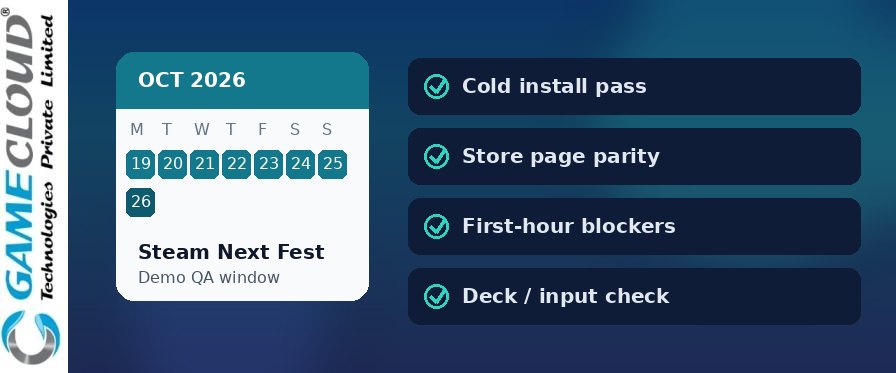
- 19-26 October 2026: the fest itself. Set the demo live (or opt out) before 10:00 AM PDT on the 19th.
Those dates move when Valve updates the page. Re-read the Steamworks October 2026 Next Fest doc before you lock your brief. None of this is a certification promise. It is a public process you reverse into a QA window.
Registration for this edition closed 31 August 2026. The September review gates (14 September for Press Preview readiness; 28 September for required fest submission) have now passed. Current event-specific QA work is for already-registered studios finishing the demo they will show. This article does not offer late registration, guaranteed festival inclusion, store approval or wishlist results.
Dates below remain Valve's published calendar for reference. Re-check Valve's official Steam Next Fest: October 2026 documentation before you lock any remaining work.
Already registered? What QA still needs to prove
If your demo is already in for Next Fest, the remaining work is proof on the build players will get, not a new registration path.
- Build stability on a cold install of the demo depot and build ID you will show.
- Store-page parity: capsule, short description, trailer first seconds and listed features match the opening minute of the demo.
- Input and Steam Deck checks where you claim controller or Deck support on the demo branch.
- Crash and blocker evidence from the first-hour loop, with severity and repro notes the studio can act on.
- Your own go / no-go or opt-out decision before fest start at 10:00 AM PDT on 19 October.
GameCloud can run an external pass scoped to that checklist when the build window and platforms are named. The studio still owns priorities, fixes and the final go / no-go call.
Distinct from a full store-window reverse calendar
An earlier GameCloud note covered when to start an external pass before a dated Steam, iOS, or Android release. That article is about the ship date and the store’s own review queue.
This article is narrower. Next Fest asks for a publicly playable demo by fest start, on a published store page, for a title that stays unreleased until after 26 October 2026. The object under test is the demo branch and the page that points at it. A green full-game night build does not prove the demo depot, the demo first-hour loop, or the page players will open from the fest shelf.
What the demo pass is for
Scope the pass to what a stranger will do in the first session during Press Preview and fest week.
- Cold install from the demo the public will get. Not an already-warmed developer machine with leftover saves, shaders, and registry crumbs.
- Store page parity. Capsule, short description, trailer first seconds, and listed features must match what the demo actually shows in its opening minute. Steam’s build review cares that claimed features exist in the current build.
- First-hour blockers. Softlocks, missing tutorials, broken saves, dead ends, and crashes that end the session before the hook lands.
- Input and Deck sanity on the demo branch. Default Steam Input config, controller glyphs, and a hot-swap path if you claim controller support. A main-branch config that never landed in the demo depot is a fest bug.
- Performance that survives a featuring spike long enough for a first session: boot time, hitching in the opening area, audio that wakes the machine while the menu sits idle if you are targeting Deck.
- Livestream and capture hygiene if you plan to stream: the demo must be stable enough to leave running while you talk.
Say what is out. Console certification checklists, where you have them, stay a process with the platform holder. An external partner who sells “we will pass cert for you” as the Next Fest deliverable is selling the wrong pass. Same for inventing a device-lab headcount or a tester-pool number in the brief.
Book the pass against the submit date, not fest day
Valve's published gates were 14 September for Press Preview readiness and 28 September for the hard "all items in review" requirement. If you are already registered and still preparing the demo players will see, work from the remaining Press Preview (8 October) and fest start (19 October) dates, not from fest day alone.
- Freeze demo scope before the pass. No new systems mid-test unless you rebook the pass.
- Leave one programmer fix cycle after the first useful bugs and before you mark the build ready for Steamworks review.
- Test the build ID you will upload. Branch renames and depot mismatches break influencer keys, press keys, and UTM plans as often as gameplay bugs do.
- Rehearse a clean install after you promote the demo depot, not only in CI on a developer image.
If today is already inside that window, shrink the pass. Prioritise cold install, crash paths in the first hour, store parity, and input on the demo branch. Do not spend the last days on polish that cannot ship in the submitted build.
Brief the partner in one page
You do not need a novel. You need rails that match the fest.
- Exact demo AppID / branch / build label and the store page URL players will open.
- Platforms in this demo drop only. Name PC, iOS, Android, TV, Web, XR and other emerging platforms only if the demo actually ships there. Cross out later SKUs.
- Must-pass list: cold install, first-hour loop, save/load, store-claimed features, Steam Input / Deck if claimed, crash and blocker severity.
- Out of scope: full game content beyond the demo, certification paperwork, marketing copy rewrites, live-ops tooling you will not ship in this build.
- Fix owner and turnaround for blockers before the Steamworks submit date you chose.
GameCloud runs external game QA for studios and publishers who need a dated, store-shaped pass on PC, iOS, Android, TV, Web, XR and other emerging platforms. Tell us the build window and platforms. We will return a one-page project total. For a Next Fest demo or any other dated window, write Sales@GameCloud-Ltd.com or use contact.
Before Next Fest week, map the pass on game validation. Need external coverage for your demo window? Agree a build-specific readiness sprint and bounded retest.