
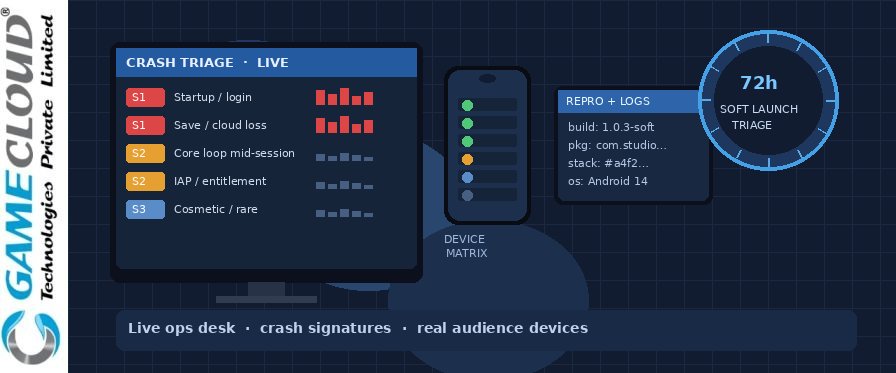
The soft-launch build is live in the test markets. Paid traffic is on. Crash and ANR charts that were quiet in the lab start moving within the first evening.
That window - the first 72 hours after strangers can install - is where most mid-size and indie teams discover the long-tail devices, OEM skins, and session paths their freeze pass never hit. Soft launch exists to learn under real load before hard launch spends the full UA budget. Stability is part of that learning. Retention and ARPDAU mean little if half the install cohort never clears the first session.
The question is not whether you "need more QA." It is what a scoped external overflow pass should own in those first 72 hours, what stays with the studio, and how you brief the partner against live packages and live telemetry - not against a wish-list build.
Why the first 72 hours after soft launch are different
Pre-ship freeze QA proves a labelled build on a named matrix. Soft launch proves the same build under a real audience mix, real networks, and real play length.
Public soft-launch practice treats the limited geo (or limited cohort) open as the place to validate stability, core loop, retention shape, and early monetisation before global scale. Industry notes repeatedly call out crash rate, crash rates per DAU, FPS, latency, and Google Play Android Vitals as the stability signals to watch. a16z's soft-launch write-up is blunt: soft launch surfaces lower-spec Android devices and long-tail configurations a lab will not buy, and Google Play points teams at Android Vitals for monitoring.
The first 72 hours concentrate the noise. New crash signatures arrive faster than the internal bench can reproduce them while also shipping the day-one content patch and answering store review questions. Device share in the soft-launch cohort often diverges from the hardware list you froze against. Server pressure, IAP edge cases, and cold-start paths that passed smoke start failing for a slice of real players.
That is overflow work: surge triage with stranger eyes and a live matrix, timed to the open - not a second full campaign and not a substitute for the people who own design and live-ops decisions.
What the external overflow pass should own in the first 72 hours
Buy a named triage pass on the soft-launch package labels, not open-ended "help."
- Crash and ANR triage against live signatures. Group by stack and fingerprint. Rank by player impact and frequency: startup and login first, then save or cloud loss, then core-loop mid-session, then IAP and entitlement, then cosmetic or rare. Hand the studio a short ranked queue, not a raw dump. Treat ANR clusters as their own ranked queue - see ANR triage in the first 72 hours below - so main-thread freezes do not hide behind crash-only reporting.
- Repro on matching hardware with logs and package IDs. Every severity-1 and severity-2 needs steps, symbolicated or annotated stack, breadcrumb or log tail, OS and device, and the exact build label / package version the player had. One reproducible blocker with a package ID beats twenty "it crashed" notes.
- Device matrix rebuilt from real audience data in the soft-launch window. Tier-1 full pass from your live mix (Steam Hardware Survey filtered to your genre for PC, Play Reach and devices for Android, App Store analytics for iOS, plus your own crash and session slices). Tier-2 smoke. Tier-3 on rotation or when telemetry spikes a cell. Promote a device into Tier-1 the hour it starts owning crashes.
- Cold install and first-session re-checks on every store-facing soft-launch package in scope - Steam depot / IPA / AAB, and Web or XR package only if that SKU is in this soft open. Fresh account, fresh device, no leftover saves.
- Interrupt and long-session paths the freeze often under-samples. Backgrounding, incoming call, low memory, overnight suspend/resume, and multi-hour sessions on Tier-1 phones and PCs that match the soft-launch cohort.
- Severity discipline tied to the soft-launch decision clock. Mark what must hotfix before the next paid spend bump, what can wait for the next soft-launch build, and what is out of matrix. Tie each row to the package ID so engineering does not chase a ghost build.
Scope the pass to the soft-launch packages and the 72-hour clock. Overflow is surge triage and matrix coverage under live traffic. It is not live-ops ownership and it is not design acceptance.
ANR triage in the first 72 hours (Android-first, not a crash clone)
Crash dumps and ANRs are related stability signals. They are not the same commercial problem.
A crash ends the process. An ANR (Application Not Responding) means the app stopped responding to input long enough for the OS to show the system dialog or to record a vitals ANR - often from main-thread stalls, lock contention, blocked I/O on the UI thread, or a freeze that never fully dies. Players experience "tap does nothing," a system wait dialog, or a soft lock that looks like a bad network day. Soft-launch cohorts on diverse Android OEM skins surface ANRs that a freeze pass on two lab phones will not.
If Android is in this soft open, the external overflow pass should treat ANR as a first-class queue beside crash - especially startup, login, first match or first level, shop open, and ad or IAP surfaces if those offers are live.
What ANR ownership looks like in the 72-hour pass
- Separate ANR queue from crash queue - group by fingerprint or vitals cluster where you can share access; rank by affected sessions and whether the player can recover without force-stop.
- Repro for severity-1 and severity-2 ANRs - steps, approximate stall point, logcat or breadcrumb tail, OS and OEM build, device identity, and exact AAB version code / package label. Note whether the system ANR dialog appeared or the session soft-locked without a dialog.
- Main-thread and lifecycle suspects worth probing - first-frame after install, permission dialogs, heavy first-scene load, returning from background, orientation change, and opening IAP or rewarded-ad flows named in scope.
- OEM and skin long-tail - promote devices into Tier-1 when vitals or your crash/ANR slice shows a skin or chipset owning ANR rate, not only crash rate.
- iOS hang and watchdog cousins - when iOS is in the same soft open, capture hang-style soft locks with the same package-ID discipline even though the OS label is not "ANR." Keep Android vitals language for Android SKUs.
- Decision clock - mark which ANR clusters must hotfix before the next paid spend bump, which can wait for the next soft-launch binary, and which are out-of-matrix noise.
What ANR triage is not
It is not a full performance lab engagement, not a rewrite of your Android architecture, and not ownership of Play Console or App Store accounts. Read-only vitals or crash dashboard access for the 72 hours (where you can grant it) turns ANR work from guesswork into ranked engineering input.
Brief add-ons for ANR
Add to the one-page soft-launch brief: whether Android Vitals (or equivalent) ANR charts are visible to the partner; which startup and mid-session flows are ANR-critical; and which OEM devices already dominate your soft-launch cohort. Keep Web, TV, XR, and other emerging SKUs out of the ANR brief unless that package is actually receiving installs in this window.
Need a standing mobile matrix after the soft-launch window? See mobile game testing on Core Services and fixed-scope monthly QA for live games - different buyer questions from this 72-hour triage pass. Also: same-week PC and mobile ship overflow scoping, closed testing tracks are not a QA pass, and core game testing services.
Add ANR ownership to your first-72-hours overflow brief. Send soft-launch dates, Android package labels, and the vitals or crash access you can share. We will return a one-page project total - write Sales@GameCloud-Ltd.com or use contact for a one-page project total.
What stays with the studio
Keep ownership where authority and product memory already live.
- Design acceptance and house style. The partner reports what broke and how often. The studio decides intended behaviour and whether a "crash" is actually a kill-switch or a known soft-launch experiment.
- Fix ownership and merge order. Name who picks severity-1, who cuts the hotfix branch, and who signs the next soft-launch binary. Overflow feeds the queue; the studio owns the commit.
- Store and account ops. App Store Connect, Play Console tracks and staged rollouts, Steam branches, tax, age rating, privacy questionnaires, and review replies stay with the studio. The partner can smoke the flows the listing claims. The studio owns the store accounts and the forms.
- Claims freeze and public messaging. Do not promote a feature the triage queue just made unstable. Community and store-reply tone stay with the people who speak for the title.
- Live-ops decisions. Feature flags, economy levers, geo expand or pause, UA budget steps, kill or extend the soft-launch market - those are producer and live-ops calls. Overflow can flag that a cell is unsafe to scale into. The studio decides whether to scale.
- Soft-launch success criteria. Retention bands, monetisation read, and go / extend / kill criteria stay with the studio. Stability triage is an input to that decision, not a replacement for it.
If Web, TV, XR, or another emerging SKU is not in this soft open, cross it out of the brief. Do not ask the partner to triage a package players cannot install yet.
Brief the 72-hour pass against live packages and live telemetry
The brief is one page. It matches the soft-launch build and the dashboards you already watch.
- Exact package labels in the soft open: Steam AppID / depot / branch, App Store Connect build, Play track and AAB version code (plus Web or XR package only if live). The package players download is the package under triage.
- Platforms in this soft open only. Name PC, iOS, Android, Web, TV, XR and other emerging platforms only if that SKU is receiving installs in this window.
- Crash and vitals access the partner needs for the 72 hours (read-only where you can): crash dashboard, Android Vitals or equivalent, session and device slices. Without signatures, triage is guesswork.
- Must-own list for hour 0-72: startup/login, save/cloud, core-loop blockers, IAP/entitlement on claimed offers, Tier-1 device coverage from live mix, interrupt and long-session smoke.
- Severity rubric you will honour: what is hotfix-now, what is next soft-launch build, what is park. Attach repro, logs, and package ID as the definition of done for a ticket.
- Out of scope: full balance redesign, UA creative testing, store-metadata rewrites, live-ops flag ownership, certification paperwork for platforms not in this soft open.
- Named studio fix owner, tracker project, and the hour each day a severity-1 must land to make the next soft-launch binary.
Public soft-launch guidance is consistent on one point: soft launch is for learning under real players before hard launch. Your brief has to leave engineering cycles inside the 72 hours to act on what triage finds - otherwise the overflow pass only produces a list you cannot ship against.
Book overflow against the soft-launch clock, not the hard-launch fantasy
Work forward from the moment strangers can install.
- Start the overflow pass when the soft-launch packages go live, or a few hours before if you need matrix warm-up on the same labels. Mid-pass content drops without a new package ID reset what you proved.
- Staff the first evening and the second morning hardest. Signature volume and device novelty usually peak early; day-three is for confirming hotfixes and watching promoted matrix cells.
- Keep a rollback or staged-rollout lever the studio already owns. If a severity-1 spikes after a soft-launch content push, pause the percentage or the geo rather than hoping overnight.
- If paid spend is about to step up inside the 72 hours, lock triage ownership before the spend bump. Scaling into an unstable cell burns the soft-launch cohort you still need for retention reads.
Soft-launch day-0 to hour-72 is a coordination problem. The overflow partner is how you buy crash triage, live-matrix coverage, and severity with repro - without pretending the internal bench can absorb every new signature while also owning design, fixes, and live-ops.
Talk to GameCloud about the first 72 hours
GameCloud is a 16-year-old company and an external game QA partner for PC, mobile, web, XR, and other emerging platforms. Studios and publishers use a scoped overflow pass when the internal team cannot cover crash triage and live device coverage in the first 72 hours after soft launch - across PC, iOS, Android, Web, TV, XR and other emerging platforms in that soft open.
Send the soft-launch dates, the live package labels, and the crash or vitals access you can share for the window. We will return a one-page project total. Write Sales@GameCloud-Ltd.com.