
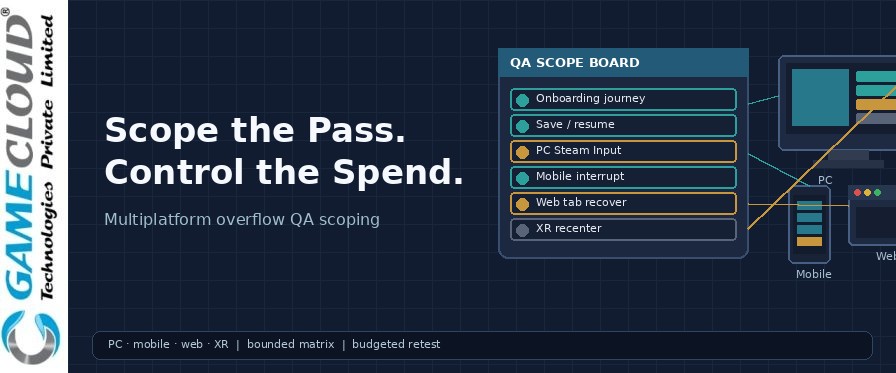
Your next build needs coverage, but the internal QA team is already handling feature checks, bug triage and release preparation. A focused external pass can take a defined testing workload off that team while keeping production in control of priorities and spend.
GameCloud is an external game QA partner for PC, mobile, web, XR, and other emerging platforms.
Start with the release question the additional coverage must answer. Then agree the player journeys, platform configurations, test depth and evidence required. That is a scope a producer can approve and a QA lead can hand over.
Start with a release question, not a tester count
"Test everything across all platforms" leaves the external team to decide what matters. Replace it with a decision-oriented brief: establish whether the latest onboarding and save changes work on the agreed release configurations, identify blockers, and verify selected fixes.
Specify:
- The decision: What will production do with the results, and when?
- The build: Which branch, build identifiers, backend environment and feature flags are being assessed?
- The risks: Which changed systems, player-facing failures and existing defects need attention?
Use recent changes, support issues and available player-device data to rank the work. Where evidence is limited, label the assumption behind the priority. Keep the first pass narrow enough that its results can change an actual production decision.
Give the external team a complete work package
For the overflow pass, assign the partner ownership of the agreed test matrix, test execution, bounded exploratory sessions, reproducible defect reports, coverage updates and approved fix verification. Include the setup and reporting work needed to deliver that package.
Keep product intent, expected behaviour, build delivery, engineering fixes, final defect priority and release approval with the studio. Ask the external team to recommend severity and explain player impact; let the studio decide the repair order against its milestone.
Name one studio decision-maker and one external lead. Give each test area an owner so internal and external testers can coordinate without repeating the same work. Agree a short triage window, an urgent-blocker contact and a fallback assignment when a question needs an answer.
Separate shared journeys from platform-specific coverage
Build the plan around player journeys, then add the platform conditions that could change the result.
A shared journey might cover launch, profile selection, onboarding, a gameplay session, saving and returning. Specify expected outcomes, test-account state and any differences between platform versions.
Use these platform-specific prompts to select relevant coverage:
- PC: Name operating systems, CPU and GPU configurations, memory, graphics drivers, display settings and input devices. For Steam Input integrations, include controller prompts, text entry and supported mixed-input behaviour. Valve documents these as distinct parts of controller support.
- Mobile: Specify Android and iOS device models, OS versions and relevant screen sizes. Include app switching, lock and resume, interruptions and network changes where they affect the selected journeys. Android's core quality tests explicitly cover interruptions and lifecycle transitions.
- Web: Record the browser, version, OS, device and deployment URL, including any embedded-player context. Check loading, cache and update behaviour, save persistence, audio start and returning to an inactive tab. Browsers can throttle background timers and pause animation callbacks, making session recovery worth explicit attention.
- XR: Name the headset, runtime, input method and supported play mode. Select checks for tracking recovery, recentering, system-menu focus and input switching. Meta's Quest test plan treats focus handling and transitions between hands and controllers as separate checks.
Confirm physical device availability before agreeing the matrix. Record any simulated coverage separately. For a shared backend or supported cross-platform multiplayer, define the client combinations, account states and simultaneous-player setup explicitly.
Set the depth for every configuration
Avoid treating each device as an identical assignment. Give each configuration a reason to be included and a defined test depth.
Use three practical levels:
- Smoke: Confirm installation or loading, launch, essential navigation and access to the selected gameplay.
- Targeted regression: Execute specified cases around changed systems, related dependencies and important existing functionality.
- Focused exploration: Investigate a named risk within an agreed session length, recording what was attempted and what remains unresolved.
Apply these levels to named configurations in a matrix. Each row should identify the build, journey, configuration, priority, test depth, owner and result. Put deeper coverage where the release risk justifies it; use narrower checks elsewhere. Preserve essential platform-specific checks even when the shared gameplay has already been covered on another device.
For performance work, supply the studio's targets and measurement conditions: scene, settings, session length, device state and evidence format. Record an observation as an observation when an acceptance target has not yet been agreed.
Agree entry conditions and protect the budget
Before execution starts, confirm that the team can access the right build, reach the intended content and report into the agreed tracker.
Provide installation instructions, test accounts through an approved secure channel, required entitlements, save files or progression shortcuts, change notes, known issues and expected results for ambiguous features. Identify who can restore access or reset test data.
Set a total effort or cost cap, with an agreed allowance for onboarding, execution, defect reporting, coordination and retesting. State how blocked time and replacement builds will be handled.
For multiplayer work, distinguish elapsed session time from total tester-hours. Agree the number of participants needed simultaneously and who supplies the other clients or players.
If a build fails the entry smoke check, report the blocker and follow the agreed pause or reassignment rule. Preserve the remaining budget for approved work rather than silently consuming it on repeated setup attempts.
Control build changes and retests
Tie every result to a build and environment. When a replacement build arrives, request change notes and decide which earlier results remain relevant.
Agree the change process before the pass:
- New build: Identify affected areas and approve any additional smoke or regression work.
- Fix verification: Name the tickets, configurations and replacement build to be retested, with an agreed effort allowance or cycle limit.
- New request: Record its estimated effort and decide whether to replace lower-priority work or increase the approved scope.
Define a stop condition: completion of the agreed work, the effort cap, or the decision deadline. At that point, hand back the evidence and outstanding items for a production decision.
A retest should establish whether the reported issue is resolved and whether the agreed nearby checks still pass. Make broader regression a visible scope decision.
Ask for evidence that supports triage
Agree the defect format before the first report. Require the build, environment, account or save-state prerequisites, reproduction steps, expected and actual results, observed frequency and supporting evidence where available.
Keep severity separate from scheduling priority. Describe the consequence: progress lost, purchase inaccessible, session interrupted or interaction blocked. Route potential release blockers through the agreed urgent channel.
For coverage, use separate statuses for passed, failed, blocked, not run and deferred. Report against the agreed matrix, not just a total number of tickets.
The closing summary should connect results to the original release question: what was covered, which builds support those results, what remains unresolved, and which untested areas need an explicit risk decision. Keep completion of the test assignment separate from the studio's release approval.
A producer-ready scope example
For a hypothetical onboarding and save update, a brief could read:
Assess the named candidate builds against the attached platform matrix. Prioritise first-session completion, save and resume, and the listed platform-specific interruption checks. Run the agreed smoke set on every selected configuration, targeted regression on priority configurations, and the time-boxed exploratory sessions.
Use the studio tracker and severity definitions. Escalate progress-loss and access blockers to the named lead. Work within the approved effort cap, including reporting and the reserved retest allowance. Additional builds or coverage require a priority swap or scope approval. Hand back the coverage matrix, unresolved defects, retest results and remaining risks before the release review.
Complete that brief with actual configurations, owners, allowances and dates before commissioning the work.
Bring GameCloud a defined testing problem
When your internal team is at capacity, start the conversation with the build window, supported platforms, recent changes and the testing work you need covered.
GameCloud is a 16-year-old company and an external game QA partner for PC, mobile, web, XR, and other emerging platforms. Talk to GameCloud about shaping that workload into a scoped overflow QA pass with agreed priorities, coverage and deliverables. The useful handover is specific: the work the external team will own, the decisions your studio will retain, and the evidence you need for the next milestone.
Send the build window, supported platforms and the QA work your team needs covered. We will return a one-page project total. Write Sales@GameCloud-Ltd.com.