
You want production access on Google Play. The build is close. Friends and a short closed track feel like enough.
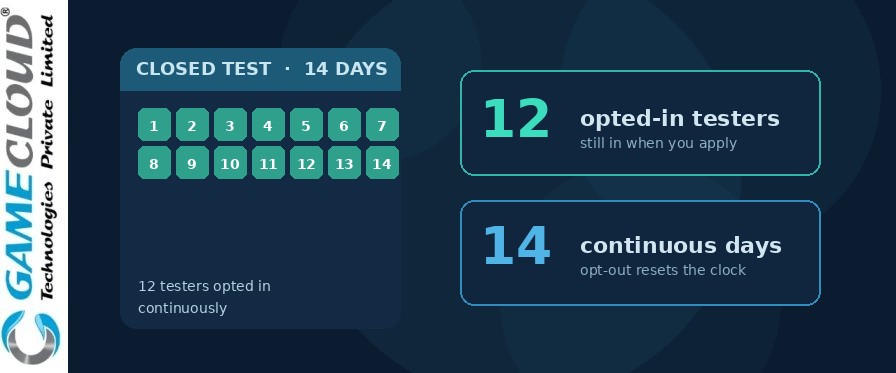
For many personal developer accounts created after 13 November 2023, Play still blocks that path until a closed test meets a hard continuity bar: at least 12 testers opted in continuously for 14 days, and still opted in when you apply. That is a planning problem for your QA calendar, not only a Console checkbox.
This note is about what that gate does to headcount, freeze timing, device coverage, and the reverse calendar from application day. Treat Play Console Help as process. Meeting the criteria lets you apply. Google still reviews the application.
The rule in plain words
Play Console Help for personal accounts created after 13 November 2023 is clear on the closed-test gate before production access:
- Run a closed test with a minimum of 12 testers who have been opted in continuously for at least 14 days.
- At least 12 must still be opted in when you apply for production access, and they must have been continuous for the preceding 14 days.
- Testers who opt out before 14 days do not count. If someone opts out and opts back in, the 14 days must be consecutive again.
- When you meet the criteria, you can apply from the Dashboard. Google reviews the submission - usually within seven days, sometimes longer - and may ask for more testing.
Internal testing is optional and recommended for early trusted builds. Closed testing is the gate for these personal accounts. Open testing becomes available after you gain production access. Organization accounts follow Play's separate path; check Console for that account type rather than copying personal-account numbers onto an org setup.
Play also stresses a practical detail: tell testers they must stay opted in for the continuous 14 days. Continuity fails quietly when people leave the track early.
Why a short friend list fails the continuity calendar
Six people for a week does not clear this bar. Twelve people who drop to ten on day nine does not either. The clock cares about continuous opt-in count, not how many emails you sent on day one.
Plan the calendar as continuity first:
- Recruit a buffer above 12. Assume some invitees never opt in, some leave after a session, and some devices bounce between accounts.
- Start the 14-day window only when you already have a stable opted-in cohort, not when you hope the last three will join mid-week.
- Keep a daily or every-other-day check on opted-in count in Console. A silent opt-out on day 12 can push application day.
- Brief testers in writing: stay opted in for the full window even if they finish their play pass early.
The gate measures opted-in presence. It does not measure how hard each person tested. That is why continuity planning and QA planning sit side by side.
What this does to the Android QA plan
Treat the closed-test AAB as a freeze candidate before you start the 14-day clock. Mid-window content drops that force a new package can reset what you already proved on cold install and first session - and they do nothing to help if testers churn off the track.
Sequence the work like this:
- Cold install and first-session blockers on the closed-test package before continuity day 1. Login, tutorial, save, IAP smoke if claimed, and crash paths that end the first hour.
- Freeze the closed-test build label you will keep through the 14 days, or name the exact package IDs you will allow if a hotfix is unavoidable.
- Separate device coverage from opt-in headcount. Twelve opted-in testers is not twelve device types covered. Build a Tier-1 Android matrix from your target audience and OEM mix, then use the closed cohort as soak and feedback - not as the whole device lab.
- Keep a feedback channel the studio can summarize later. Play's production-access form asks about the closed test, engagement, and what you changed. Structured notes from a QA pass make that form faster than a Discord scroll.
External Android QA owns severity with repro, matrix coverage, and a clean first-session read on the package under test. The Play gate owns proof that a continuous closed cohort existed. Buy both on purpose.
What the Play gate proves vs what a structured QA pass proves
The closed-test rule proves a testing window to Google for personal accounts under that Help article: enough continuous opt-ins, then an application Google can review. It is eligibility to ask for production access, not a certification stamp and not a crash-rate guarantee.
A structured Android QA pass proves something different: cold install from the track package, first-session blockers, severity with logs and package IDs, and coverage across the devices your players actually use. That pass protects the goodwill of the closed cohort and the answers you will give on the production-access form.
Studios that start the 14-day clock on a build that still softlocks on first open burn continuity and tester patience at the same time. Studios that finish a focused pass, then start continuity on a frozen package, use the gate for what it is - store process - while QA owns build confidence.
Reverse calendar from application day
Work backwards from the day you want to click Apply for production:
- Application day: at least 12 still opted in with 14 continuous days behind them. Form answers ready on closed-test engagement, app value, and production readiness.
- Application day minus ~7 (or more): buffer for Google's review. Play states review usually takes seven days or less and can take longer. Do not book a hard public launch on the optimistic end of that range.
- Application day minus 14: continuity day 1 - cohort already at or above 12 opted in, testers briefed to stay, closed-test package frozen or tightly controlled.
- Before continuity day 1: cold-install and first-session QA on that package, device Tier-1 smoke, feedback channel live, invite path rehearsed (opt-in link works on a clean Play account).
- Recruitment week before that: buffer invites above 12, clear instructions, and a named owner watching the opted-in count.
If your store window is already tight, shrink the QA pass to cold install, first-session blockers, and Tier-1 devices - then protect the continuity window as a non-negotiable block on the calendar.
Brief an external partner in one page
One page is enough if it matches the Play track:
- Play package / AAB version code and closed-test track name for the continuity window.
- Must-pass list: cold install, first-session blockers, login/save, claimed features, crash severity with repro.
- Device Tier-1 list for this Android SKU (and TV or other form factors only if that package is in this closed test).
- Feedback channel and ticket format you will reuse when answering Play's closed-test questions.
- Freeze date for the continuity package and the named studio owner for hotfixes.
- Out of scope for this pass: store-account ops, production-access form submission, and platforms not in this Android closed test.
GameCloud is a 16-year-old company and an external game QA partner for PC, iOS, Android, TV, Web, XR and other emerging platforms. Send the closed-test dates, package labels, and the Android matrix you care about. We will return a one-page project total. Write Sales@GameCloud-Ltd.com.